
Quick Summary
Building a fantasy sports app in 2026 costs between $40,000–$120,000+ depending on scope. A single-sport MVP takes 8–12 weeks and runs $40,000–$50,000. A full-featured single-sport platform cost starts from $90k and takes over 4-6 months. A multi-sport platform requires $120,000+ and 6–9 months. Key cost drivers are game format complexity (draft-based is the most expensive), infrastructure scale, mobile strategy (PWA vs. native adds 30–40%), and the experience level of your development partner, inexperienced teams add 50–100% to budgets. Ongoing data feed subscriptions run $1,000–$10,000+/month.
Introduction
Fantasy sports development looks straightforward on paper. Users pick players, earn points, and compete in leagues. Simple, right? However, sports apps operate and break in ways regular apps never do.
Real problems appear when real money enters your fantasy sports app, when users care deeply about outcomes, and when everything must work perfectly during a three-hour window on Saturday afternoon.
In less than a decade, when I worked at FanHub, building a fantasy sport platform took 1.5 years and a large team of architects, analysts, DevOps, QAs, PMs, and engineers.
What once required a year-long effort and large teams, Uinno now delivers in months with a lean, senior team achieving 7x faster time-to-market and 4x cost efficiency through cross-platform development and proven sports app development services.
This article shares what I’ve learned from developing fantasy apps across three continents. If you want to build a fantasy sports platform, you need to know what actually happens when you scale from 100 users to 100,000.
What is FanHub and How It Shaped My Sports Tech Development Experience
FanHub Media Holdings started in 2012 as an Australian company that became a global leader in digital fan engagement through free-to-play (F2P Fantasy) sport games. The company built technology solutions around two core offerings:
- fantasy sports platforms
- social activation tools for fan engagement.
By the time Genius Sports acquired FanHub in 2021, we had developed over 50 products across multiple geographies and languages, serving some of the world’s most prestigious sports organizations.
FanHub’s client portfolio included the NFL, Major League Baseball, MLS, MotoGP, Euroleague, and Cricket Australia, NBA trivia and more. We also worked with major betting operators like Betway, PointsBet, and Bet365, plus media companies including Telegraph Media Group and News Corp.
We built fantasy platforms for AFL Dream Team, NFL Draft, and NRL Draft where each required completely different mechanics and sport-specific logic.
Before starting Uinno, a fantasy app development company, I worked on these fantasy sports platforms from the early days when we built everything from scratch. The team was passionate about sports and put in overtime willingly because we created products that didn’t exist in Australia at the time.
I saw how the client’s connection to sports drove everyone’s dedication. On weekends during games, half the team monitored support because the server load was enormous. We configured email distribution, dealt with external data providers who changed formats without notice, built draft systems with real-time counters, timers, and complex dependencies that had to handle massive volumes of information across hundreds of leagues running simultaneously.
This experience taught me what actually breaks in sports tech development, what users care about during critical moments, and why certain technical decisions matter more than others. The work I did at FanHub across multiple sports and continents gave me insights you can’t get from building one app for one market.
Core Fantasy App Features That Drive Retention and Revenue
Every feature in a fantasy sports platform serves one purpose: keep users engaged and convert that engagement into revenue. After building 50+ products, I know exactly which features move these metrics and which ones waste development budget.
Live Draft Experience
The draft determines whether users stay for the entire season. It’s your first major interaction, and it happens once. Get it wrong, and a few thousand people simultaneously decide never to use your platform again.
Real-Time Scoring and Updates
Users refresh fantasy app constantly during live games. Score update speed determines whether they trust your platform as their primary source.
- Revenue impact. Paid fantasy sports leagues require instant scoring because users make lineup decisions based on live data. A 30-second delay costs commissioners games they would have won. They won’t renew subscriptions if your competitor updates faster. We tracked user retention: platforms with <5 second score delays kept 78% of paid users season-over-season. Platforms with >30 second delays kept 41%.
- What We Built. Data processing pipelines that handle feeds from multiple sources, calculate points across thousands of leagues simultaneously, and push updates to users within seconds. When Patrick Mahomes throws a touchdown, every fantasy team that owns him sees those points update immediately across all devices.
- Retention driver. Speed builds trust. Users who see scores update instantly treat your platform as authoritative. Users who experience delays check competitor apps for verification, then eventually switch.
Intelligent Player Recommendations
Users want help making decisions without doing hours of research. Recommendation features reduce friction and improve outcomes, which drives engagement.
Payment and Prize Pool Management
Money changes everything. When users pay to enter leagues, they expect professional-grade reliability and transparency.
- Revenue Impact. This feature IS revenue. Paid league entry fees, subscription tiers, ads, and prize pool management generate 60-80% of platform revenue, making this a critical aspect of fantasy sports app monetization. A single payment failure during sign-up season costs you that user’s entire season value. Payment processing must be PERFECT!
- What We Built. Integration with payment processors across multiple regions (Australia, UK, US), escrow systems for prize pools, automatic payout distribution, refund handling when leagues disband, and compliance with different gambling regulations by jurisdiction. We processed millions in league entry fees.
- Retention Driver. Users trust platforms that handle money professionally. Clear prize pool tracking, instant payouts, and transparent fee structures build loyalty. Payment problems destroy trust permanently.
League Communication and Social Features
Fantasy sports are inherently social. Users play with friends. Features that enhance social interaction drive daily engagement.
Admin and Commissioner Tools
Commissioners run your platform’s ecosystem. When you make their job easier, they bring dozens of users and run multiple leagues.
- Revenue Impact. Power commissioners manage 5-10 leagues each. A single satisfied commissioner generates $200-500 in annual revenue through multiple paid leagues and sponsored competitions. Commissioners who struggle with admin tools abandon your platform and take 50-100 users with them.
- What We Built. Intuitive dashboards that let non-technical users customize league settings, resolve disputes, modify rosters, communicate with members, and handle edge cases. The admin panel had to be powerful but simple. We watched commissioners use these tools during live drafts and refined based on real behavior.
- Retention Driver. Commissioners are your champions. They convince friends to join, organize leagues every season, and defend your platform in discussions. Commissioner satisfaction has a multiplier effect on retention.
Mobile-First Experience
80% of fantasy traffic comes from mobile devices. Users check scores during games, make roster moves during commutes, and manage teams from their phones.
Data Feed Integration and Accuracy
Your platform is only as good as your data. Incorrect statistics destroy trust instantly.
- Revenue Impact. Scoring errors in paid leagues trigger refund requests that can exceed the league’s entry fees. One major data error can cost thousands in refunds and customer service hours. Users don’t blame the data provider, they will blame your platform.
- What We Built. Integrations with multiple data providers, fallback systems when primary feeds failed, error detection algorithms that flagged suspicious data, and manual override tools for the rare cases when automation couldn’t resolve issues. We monitored feeds 24/7 during game days.
- Retention Driver. Users tolerate minor UX issues. They won’t tolerate incorrect scores. Data accuracy is table stakes. One major scoring error and users lose faith in your entire platform.
These features work together as a system. Users need accurate data to trust your scoring. They need smooth drafts to commit to your platform. They need mobile access to check scores during games. They need social features to engage daily. They need reliable payments to trust you with money.
We prioritized features based on revenue and retention impact, not technical elegance. Draft systems were brutally complex to build, but they determined whether users invited friends. Mobile optimization was tedious, but it unlocked 80% of traffic. Payment integration involved regulations and compliance, but it represented 70% of revenue.
After building platforms for the NFL, MLB, and Cricket Australia, I learned that feature selection determines business outcomes. Every hour of development should drive retention or revenue.
How Much Does It Cost to Build a Fantasy Sports App?
Founders always ask the same question: “How much does it cost to build a fantasy sports app?” The answer depends on what you’re building, but I can give you real numbers from projects I’ve worked on, and what Uinno completed.
A single-sport fantasy app MVP that validates your market concept can take a couple of weeks. Modern cross-platform frameworks like React Native and Flutter, one of the best technologies for fantasy sports app development, let you build once and deploy to iOS, Android, and web simultaneously. You don’t need separate codebases for each platform anymore.
Fantasy Classic Discovery
- Cost range: starts from $4k
- Team: 1 senior consultant/architect, 1 business analyst, designer
Deliverables include:
- wireframes for all core screens;
- technical architecture recommendations;
- data provider evaluation (Sportradar vs. Opta vs. custom);
- detailed cost breakdown by feature;
- risk assessment;
- phased development roadmap.
This phase typically prevents costly mistakes by surfacing technical blockers and market realities early.
Learn more about our Discovery services
Simple MVP for a Single Sport (8-12 weeks)
- Cost range: starts from $40,000-50,000 depending on complexity and type (e.g. classic fantasy, predictor or betting)
- Infrastructure: Cloud hosting, managed database, real-time services
Essential features include:
- user registration and authentication (email/social login);
- basic team creation with budget constraints;
- player database for one league (e.g., Premier League only);
- simple scoring engine that updates after matches (not real-time during games);
- private & public league creation where friends can compete;
- basic leaderboards showing rankings;
- weekly gameweek deadlines for team changes;
- mobile-responsive web interface (PWA approach);
- simple admin panel for basic content management.
What’s NOT included: live scoring during matches, payment processing, advanced analytics, native mobile apps, draft mode, or multiple sports support.
Remember, MVP validates whether users engage with your core concept before investing in advanced features.
Full-Featured Platform for One Sport (4-6 months)
- Cost: starts from $90k
- Infrastructure: Production-grade cloud setup with auto-scaling
Key additions include:
- real-time scoring during live matches (WebSocket integration);
- live draft mode with timer-based picks and auto-pick fallback;
- payment gateway integration for paid leagues (e.g. Stripe/PayPal);
- prize pool management and automated payouts;
- comprehensive admin dashboard with league management tools;
- cross-platform mobile apps;
- push notifications for scores and league updates;
- detailed player statistics and performance analytics;
- trade system between league members;
- chat features within leagues;
- email + push notification;
- performance tracking and historical data;
- Other custom features by request.
Multi-Sport Platform (6-9 months)
- Cost range: starts from $120,000+
- Infrastructure: Enterprise cloud architecture
Core additions include:
- support for multiple sports with completely different scoring rules (NFL, NBA, MLB, Premier League, etc.);
- sport-specific position requirements and roster structures;
- tournament mode for special events (World Cup, playoffs);
- season-long and weekly game modes;
- sophisticated data feed management from multiple providers;
- white-label capabilities for partner sites;
- API for third-party integrations;
- advanced analytics dashboard with AI-powered recommendations;
- social features including global leaderboards and achievement systems;
- sponsored leagues and branded competitions;
- comprehensive CMS for content management across sports;
- multi-language support.
These numbers assume you work with an experienced sports app development company who understands sports tech like Uinno. If you hire a general app development agency without fantasy sports app development, add 50-100% to these estimates because they’ll need to learn what works through trial and error.
What Drives the Fantasy Sports App Cost
Fantasy Sports Game Type Complexity
The type of fantasy sports format directly impacts development cost and complexity.
Prediction games and ladder-style formats are usually the simplest to build. Users submit picks, results are validated, and points are assigned — with minimal state management, making these formats ideal for fast MVP launches.
Classic fantasy formats, where users manage season-long teams, introduce additional complexity through roster management, deadlines, transfers, and cumulative scoring. While still manageable, they require more robust backend logic and data handling.
Draft-based fantasy games are the most complex and expensive to develop. Their complexity comes from real-time, multi-user coordination rather than sport rules alone. Live drafts require synchronized state management, timers, concurrency handling, and fault-tolerant fantasy sports platform architecture to manage edge cases like disconnects or auto-picks.
Fantasy App’s Scale Requirements
An app for 1,000 users costs less than one designed for 100,000. Read our developer’s firsthand account of handling 900,000 concurrent users during Premier League matches to understand what scalability actually means when real traffic hits. Your infrastructure, database design, and caching strategies all change based on expected scale. We learned to build for scale from day one because retrofitting performance later costs more than building it right initially.
Fantasy Sports App Mobile Experience
Fantasy sports cross-platform apps cost less than native iOS and Android apps because you build one codebase. However, if you need specific hardware features or app store presence, native apps add 30-40% to development costs.
Your next read: Top 8 Fantasy Sports App Development Companies
The Hidden Costs Of Fantasy App Development
Budget for ongoing expenses that founders often miss:
- Data feed subscriptions. Official sports data costs $1,000-10,000+ per month depending on the sport and level of access. These fees never stop.
- Customer support during season. Users need help during live drafts and games, which happen on weekends and evenings. Factor in support coverage for peak times.
- Infrastructure scaling. Game days create traffic spikes 20-50x normal levels. Your cloud costs spike too, though they’re still far less than the old days of maintaining physical servers.
- Seasonal maintenance. Sports apps sit relatively quiet during off-season but require preparation before each season starts. You can’t simply launch once and forget it.
- Regulatory compliance. If you handle payments for paid leagues, you need legal review for gambling regulations, which vary by region. Budget $10,000-30,000 for initial compliance work.
The ROI Perspective for Fantasy Sports Apps
These costs sound high until you consider the revenue potential. A well-executed fantasy sports platform generates revenue through multiple streams:
- Paid league entry fees (users pay $10-100 per league)
- Premium subscriptions ($10-30 per season for advanced features)
- Sponsored leagues (brands pay $5,000-50,000+ for custom competitions)
- In-app advertising (personalized ads based on user interests)
A platform with 100,000 active users where 20% participate in paid features generates $200,000-500,000 in annual revenue. The development investment pays back within 1-2 seasons if you execute well.
These are just basic math, and the real revenue is highly dependent on type of sport and geography.
Fantasy App Development Cases by Uinno
PuntClub – Multi-Sport Tipping Platform Across 400 Australian Pubs
We built Punt Club as a multi-sport tipping platform that transformed how Australian pubs engage sports fans. The client came to us with a legacy product that couldn’t scale or support new sports. We rebuilt the entire platform from scratch in just 1.5 months, creating flexible backend architecture that now serves over 400 pubs across Australia. The platform handles AFL, NRL, horse racing, and integrates live bookmaker odds to enhance the pub sports experience.

Users compete in pub-based leagues, earn redeemable coupons, and climb leaderboards while watching games. The platform processes real-time data from multiple sports feeds including Ladbrokes API, Squiggle API, and NRL API, automatically finalizes rounds, and calculates tips without manual intervention.
Fantasy Tennis – A Discovery for Classic Fantasy Sports App
We conducted a discovery phase for a client who identified tennis as an underserved niche in fantasy sports. Unlike fantasy football or basketball where the market is saturated, fantasy tennis remains fragmented with existing apps offering poor user experience and limited engagement features. The client’s vision centered on creating a year-round fantasy tennis platform that covers the nine major tennis tournaments without tying to a single event, giving users continuous engagement opportunities throughout the tennis calendar.
Tennis presents unique fantasy mechanics compared to team sports. It’s an individual game where even top-200 players can’t participate in all tournaments, creating interesting roster management challenges.
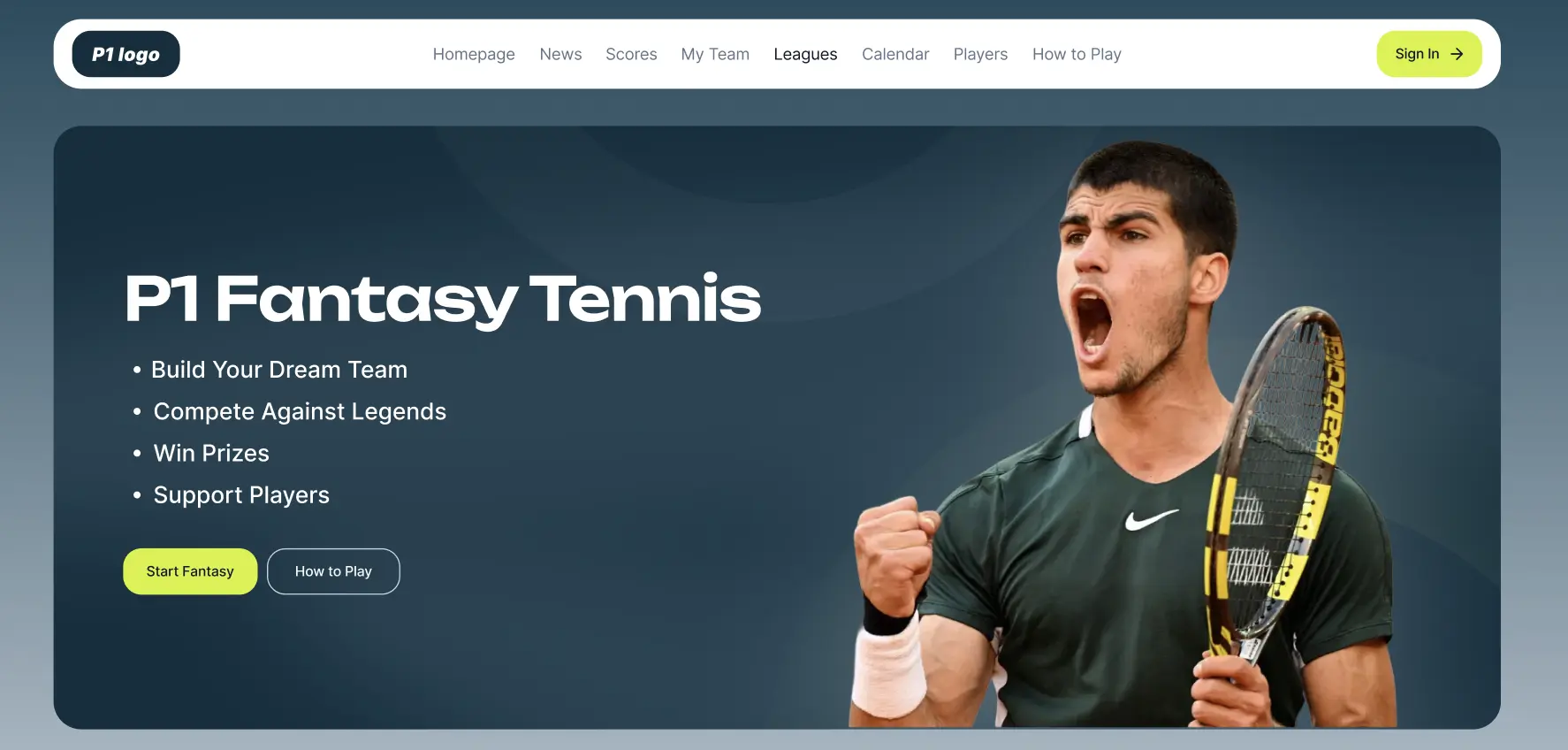
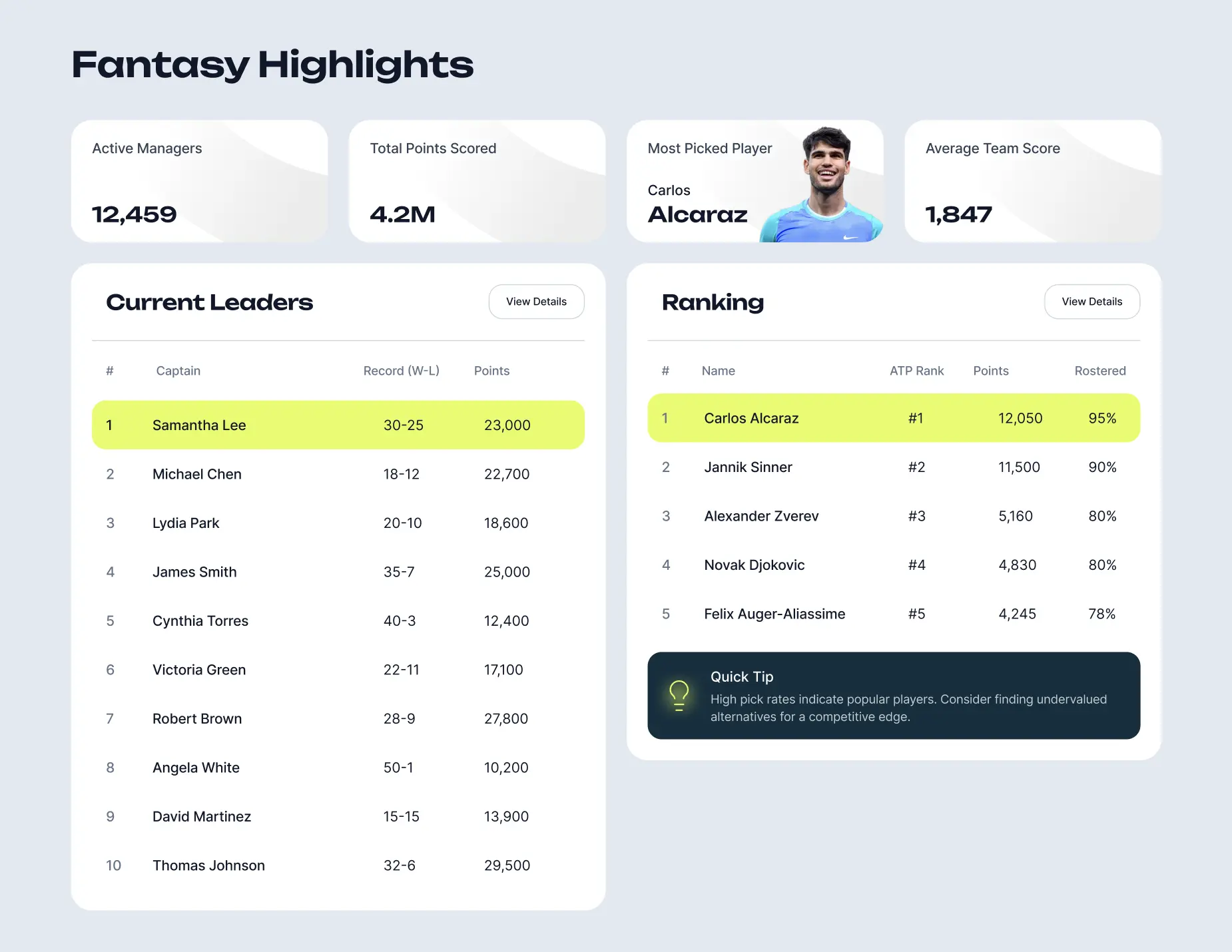
We designed a dual-league system with both private leagues (where friends compete with entry fees and direct player trades approved by league commissioners) and public leagues (with fair resource constraints to keep competition balanced).
The discovery revealed that existing tennis fantasy apps fail to educate users about players beyond rankings, so we specified detailed player cards with comprehensive statistics and risk indicators.
Learn more about our Product Discovery services and how you can benefit from a well-researched development approach.
Ladder Predictor
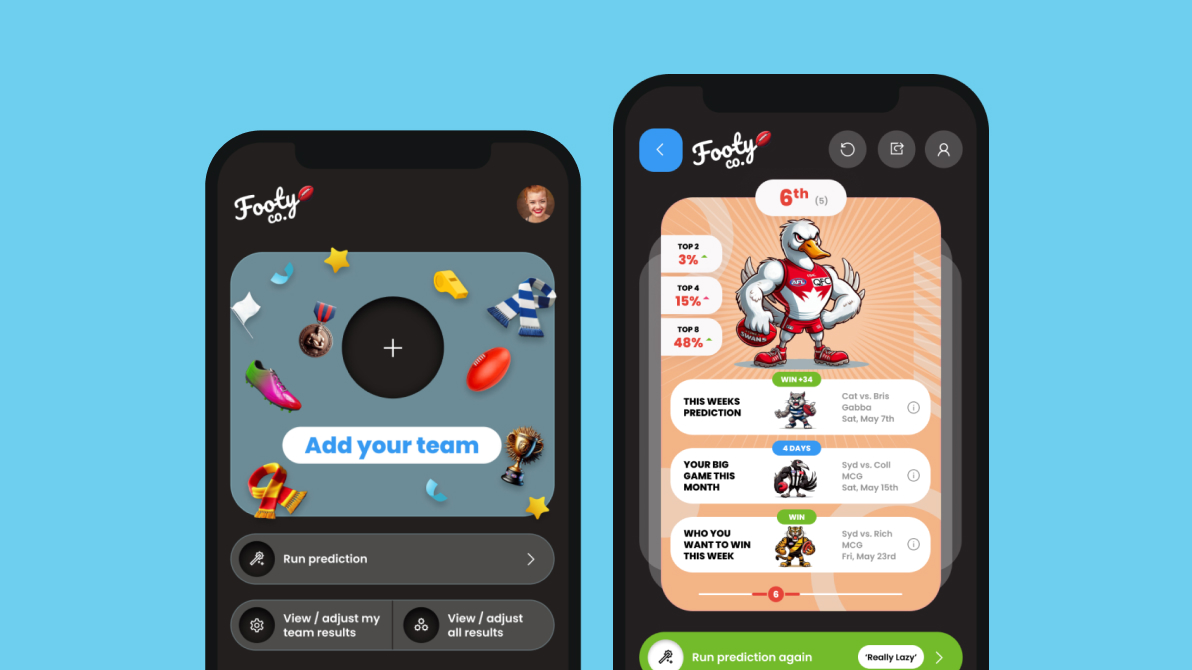
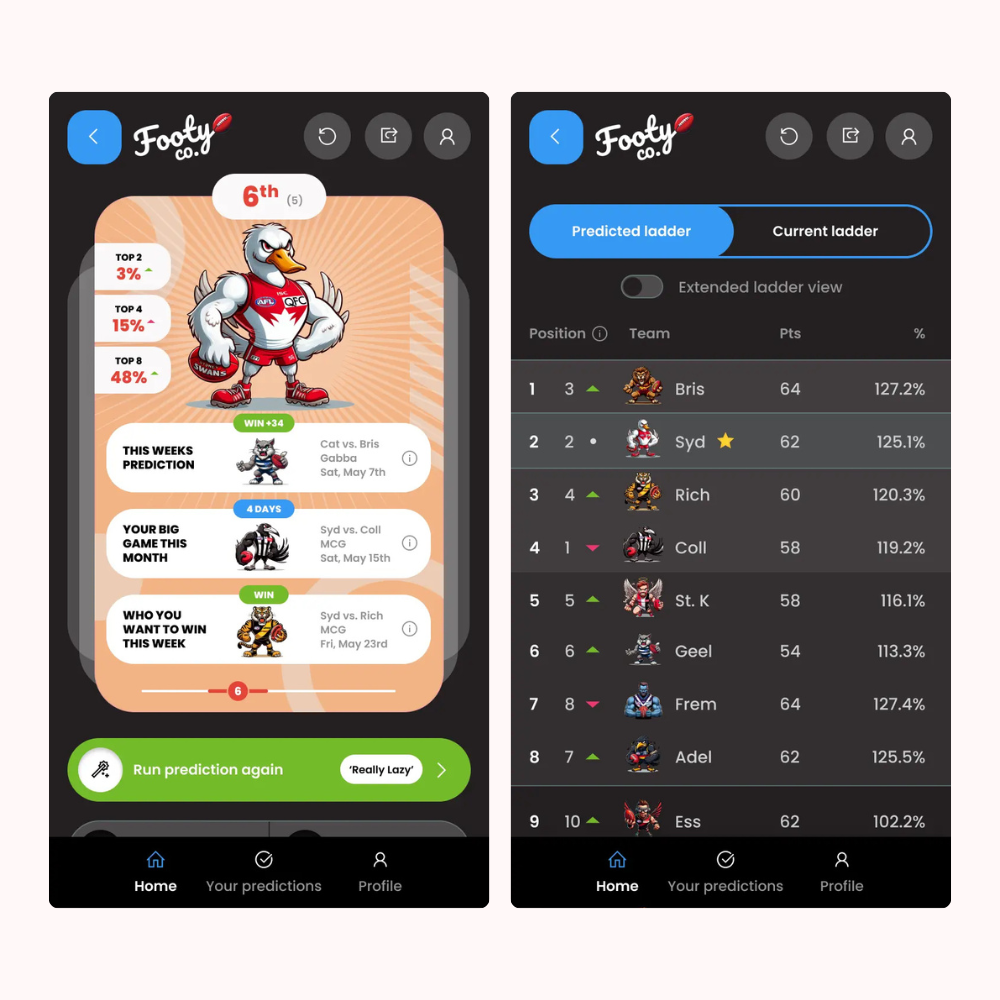
We built a cross-platform AFL ladder prediction app for Footy.co that processes 250 matches instantly and delivers predictions in 2-3 seconds. The founder had spent years developing mathematical algorithms that modeled AFL results based on stadium conditions, team history, rest periods, and hundreds of variables.
The app delivers automated predictions, advanced ladder simulations, and scenario modeling. Fans choose their settings, tap a button, and see where each team will finish plus which upcoming games matter most. We integrated the AFL API for real-time match data and built probability calculations for Top 2, Top 4, and Top 8 positions.
Rugby Fantasy
We’ve worked on fantasy rugby sports platform where the sport’s unique mechanics demanded careful implementation. The “open bench” system lets bench players score points if on-field players underperform. This requires complex automatic substitution logic that evaluates whether players actually played, their position eligibility, and minimum game time requirements.
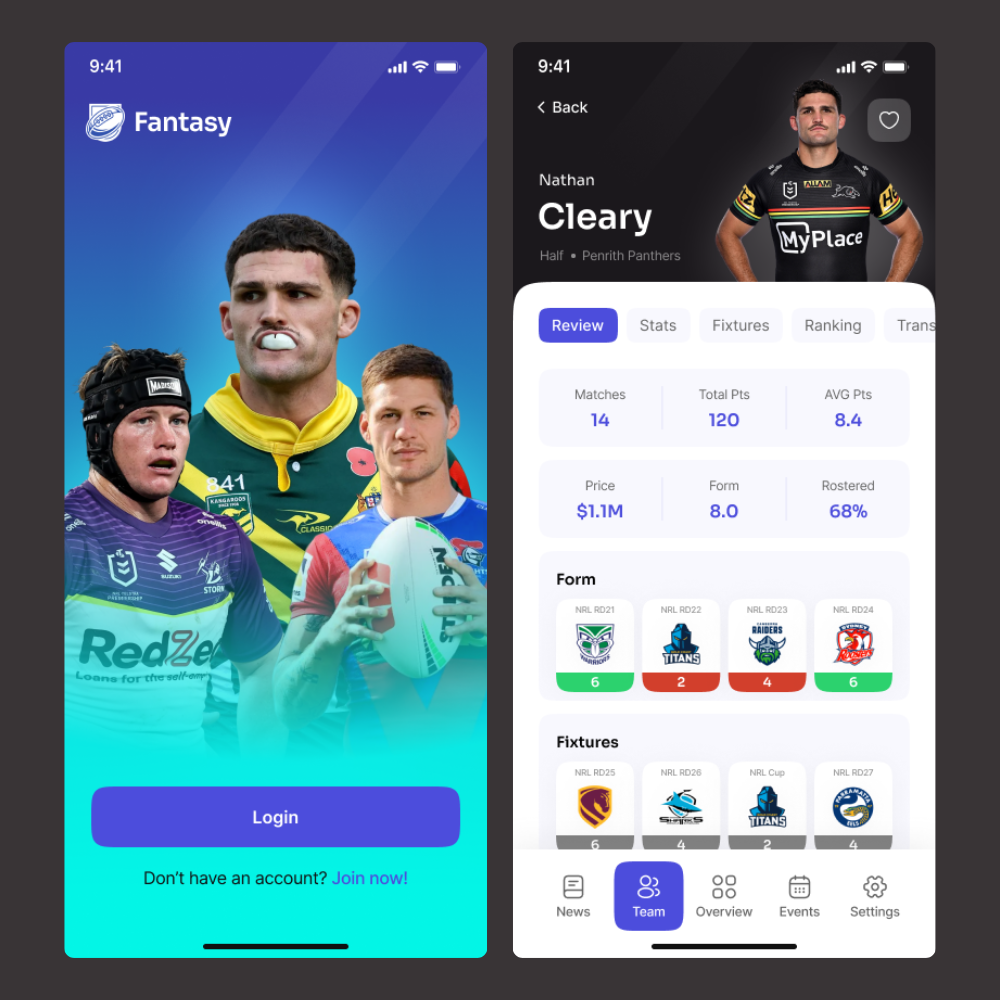
We’ve seen fantasy platforms struggle with different rugby-specific mechanics when developers treat them as simple variations of other sports rather than unique requirements. We prepared a guide for those who want to learn how to build a successful fantasy rugby app.
Hire Fantasy Sports Developers Who Know the Industry
The cheapest development option often costs the most in the long run. I’ve seen founders hire inexperienced teams who build fantasy apps that crash during the first draft, show incorrect scores, or handle payment processing insecurely. They spend the initial budget, then spend it again to rebuild with a team that knows sports tech software development.
Our dedicated development team at Uinno knows which features drive retention, which technical decisions cause problems under load, and which shortcuts create disasters. That experience doesn’t show up in the initial quote, but it shows up in whether your platform survives its first season.
The development cost matters less than the cost of failure. A platform that loses users during Week 1 because of technical problems wastes the entire investment. A platform that handles 100,000 concurrent users during playoffs builds a reputation that drives growth for years.
The Bottom Line
Fantasy sports app development became dramatically more affordable and faster since 2015. Modern tools, cloud infrastructure, and mature frameworks reduced both time and cost by roughly 7-10x. A simple tipping platform now costs $40,000-50,000 and takes 3 months. A multi-sport platform starts from $90,000. Complex draft-based fantasy apps would require $120,000+.
The core challenge hasn’t changed. You need to understand how fantasy sports work, what users expect during critical moments, and which technical decisions matter for retention and revenue. That knowledge determines whether your investment succeeds or fails.
The main question goes far beyond of just “how much does it cost?” The real question is “what do I get for that investment, and who’s building it?”
Our team has built 50+ fantasy products across the NFL, MLB, MLS, and more. Let’s discuss your project.
- Introduction
- What is FanHub and How It Shaped My Sports Tech Development Experience
- Core Fantasy App Features That Drive Retention and Revenue
- How Much Does It Cost to Build a Fantasy Sports App?
- What Drives the Fantasy Sports App Cost
- The Hidden Costs Of Fantasy App Development
- The ROI Perspective for Fantasy Sports Apps
- Fantasy App Development Cases by Uinno
- Hire Fantasy Sports Developers Who Know the Industry
- The Bottom Line
.png)
.png)