A data-driven approach to model an in-demand product that includes business analysis, proof of concept (POC), design concept, and project estimate.
A complex human-centered process of developing a valuable product that blends business goals and user needs with design thinking in mind.
Industry: SportsTech
Location: Australia
Tech Stack:
Timeline: 3 months
Platforms: Web, iOS, Android
See it live: Footy.Co
Every AFL season, fans try to answer the same difficult question: where is my team actually heading on the ladder?
The league is unpredictable, the variables are many, and traditional predictors force users to make dozens of manual inputs. Fans wanted clarity and accuracy. They wanted a tool that could instantly show realistic outcomes and help them explore what needed to happen for their team to reach the position they hoped for.
The founder of Footy.co had spent years developing a set of bespoke mathematical algorithms that could model AFL results. These calculations considered stadium conditions, team history, rest periods, head-to-head patterns, and hundreds of variable combinations. What he needed was a way to turn this deep mathematical logic into a fast, reliable, cross-platform product that any fan could use without friction.
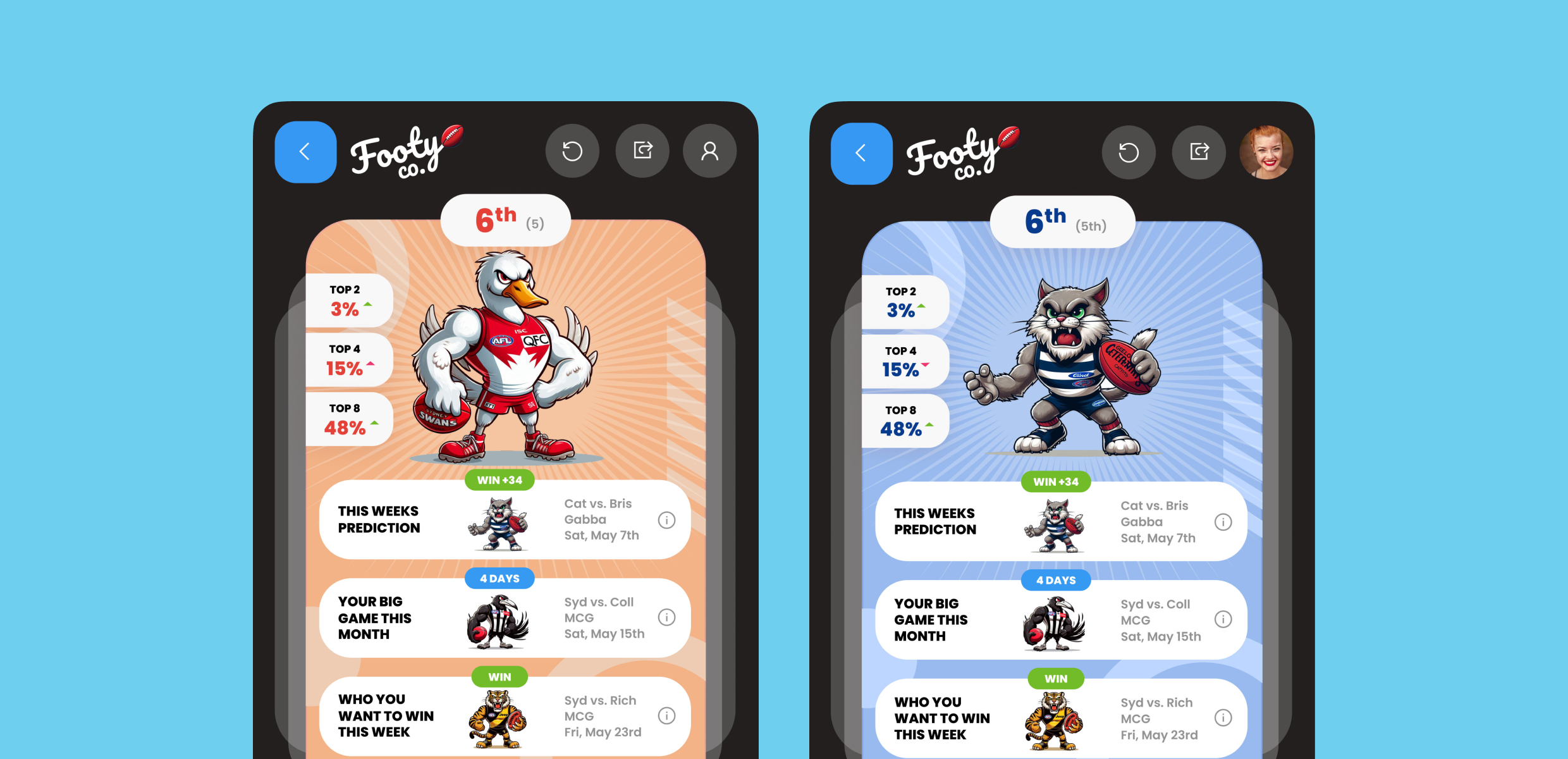
The Footy Ladder Predictor is a multi-platform application for AFL fans, available on Web, iOS, and Android.
The system delivers automated predictions, advanced ladder simulations, and personalised scenario modelling. Its core is a custom prediction engine built on top of Math.js and supported by a scalable backend architecture.
The product consists of two major components:

Lorem ipsum dolor sit amet, consectetur adipiscing elit. Suspendisse varius enim in eros elementum tristique. Duis cursus, mi quis viverra ornare, eros dolor interdum nulla, ut commodo diam libero vitae erat. Aenean faucibus nibh et justo cursus id rutrum lorem imperdiet. Nunc ut sem vitae risus tristique posuere.
We invested our time to understand the algorithm, sat with the client and mapped out every calculation. We documented everything and then we built a custom calculation engine from scratch.
The client brought his vision to life with a panel that included all the necessary features for simulations. The client could test every user action before the mobile apps were ready. This caught problems early and compressed our feedback loop from weeks to days.
The client's algorithms incredibly complex, but his openness to collaboration made it genuinely rewarding. When you understand the business logic that deeply and have a partner who trusts your technical decisions, difficult challenges become the kind of problems you actually want to solve.

We used FlutterFlow for all three platforms. Web, iOS, Android. One codebase, three outputs. This cut frontend development time by 60%.
The backend stayed traditional code. It had to. The calculation complexity demanded custom implementation.
By combining low-code speed on the frontend with a custom engine on the backend, the client received a fast-to-market product.
The result: 4x cost savings compared to building everything traditionally.

AFL fans finally got the prediction tool they deserved. Three platforms, instant results, zero frustration. What used to take 30 seconds in the first version now happens in 2-3.
The client saved $40k and can tweak every algorithm without waiting on developers. And when he's ready to add rugby or cricket, the system is already built for it.
3 months from concept to launch across web, iOS, and Android.
Our low-code/custom code hybrid approach cost 4x less than traditional development while maintaining full functionality.
We used microservices architecture and parallel processing to reduce response times from 30 seconds to 2-3 seconds.
Absolutely. We built the architecture to easily expand from Australian football to other sports and markets.
Yes. Low-code accelerates frontend development while custom backend handles complex logic. Perfect for MVPs that need to launch fast.
Yes. We integrated the AFL API for real-time match results and details without delays.
- Understanding the algorithms
- building a scalable backend
- creating intuitive UX
- optimizing for performance.
you have a vision